




















If you're relying on your menstrual cycle as a form of birth control, you might be surprised to learn that you can, in fact, get pregnant during your period.
Sure, it's one of the less fertile times of the month, but under some conditions, conception can still happen.

How can you get pregnant on your period?
The chances of getting pregnant when you have your period are low, but they're not zero. So how could a pregnancy happen at the same time your body is deciding it's not pregnant?
Let's break it down: During ovulation, your ovary releases an egg into your fallopian tube, where it can live for 24 hours awaiting fertilization. Meanwhile, the uterus is building up a lining just in case it needs to host a growing embryo.
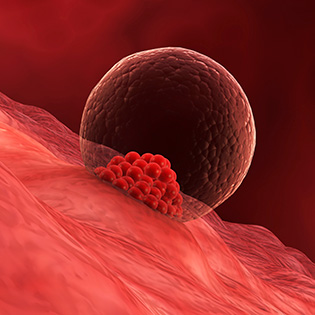
If egg meets sperm during ovulation and implants in that lining, bingo — you're pregnant. If not, your body sheds both lining and egg (aka your period).
Most women's menstrual cycles last about 24 to 28 days, from the first day of one period to the first day of the next period. The egg can survive for 24 hours after ovulation, and sperm can live inside the reproductive tract for up to five days. That means pregnancy can happen from five days before ovulation through about one day after.
"Women tend to ovulate about 14 days before they get their periods," says Mary Jane Minkin, M.D., a board-certified OB/GYN and clinical professor at Yale School of Medicine in New Haven, Connecticut.
So if you have a 28-day cycle and a week-long period, that leaves you about a week between the last day of your period and the first day you ovulate, according to the Mayo Clinic. But cycles aren't always predictable.
Even in a woman who has a 28-day cycle, the day ovulation starts can vary from month to month. And, says Dr. Minkin, "very few women have a totally constant cycle, every cycle." Because of this fluctuation, you can't guarantee that the sperm from sex during your period will be gone by the time you ovulate next.
So, for example, if you have sex on the last day of your period (day seven) and you ovulate a few days early — on, say, day 12 instead of day 14 — that sperm might still be hanging around, making pregnancy possible, Dr. Minkin explains.
Keep track of your cycles, get expert advice, and connect with other moms on the What to Expect app.
Can you get pregnant on your period if you have an irregular cycle?
Yes. If you have an irregular cycle, it can be almost impossible to predict when you'll be ovulating, says Shannon Smith, M.D., a board-certified OB/GYN and member of the What to Expect Medical Review Board. And when ovulation is unpredictable, so is your fertile window.
"I ovulate during the end of my period," says What to Expect Community member au2013. "So when we were TTC we had to have sex while I was on my period."
Here are a few types of irregular menstrual cycles that increase the odds of getting pregnant on your period:
- Short cycles: Some women have cycles as short as 21 days, which means they don't have as much time between when their period ends and they ovulate next. And since sperm can live in your reproductive tract for a few days, if you happened to have sex during your period and then ovulated two to three days later, that egg could encounter viable sperm. Which could mean pregnancy.
- Long periods: While your body is slowly shedding that uterine lining, the clock is ticking on ovulation — and your next egg could show up while you're still bleeding from the previous month's period. So you're already fertile again — which means you could get pregnant on your period.
- Breakthrough bleeding: Some women experience spotting during ovulation and mistake it for a period, says Dr. Smith. In that case, bleeding may actually coincide with peak fertility. Breakthrough bleeding can also be a sign of hormonal abnormalities or a physical abnormality in your uterus (such as polyps, fibroids, or an overly thick lining), so bring it up with your doctor even if you're not trying to get pregnant.
"Some medical conditions, like polycystic ovary syndrome, can cause irregular cycles," says Dr. Smith. "Also, women in their teens and early 20s who have recently started their period, as well as women in perimenopause in their 40s, have more unpredictable periods due to hormone fluctuations."
Sometimes, however, an irregular period can be a sign that you're not ovulating at all, which is one cause of infertility. (You can't get pregnant if you don't ovulate.) If you have an irregular menstrual cycle and you've had trouble getting pregnant, talk to your doctor, who may want to do a further evaluation.
Can you get pregnant right before your period?
It's not impossible, but it's unlikely — especially in women with regular, 28-day cycles. Ovulation is normally complete by day 19, a solid week-and-a-half before your next menstrual period begins.
That said, ovulation is harder to predict in women with irregular periods, which means it could happen later in the cycle, close to the start of your period. Plus, even in women with regular cycles, ovulation can vary from month to month, especially if you're stressed, traveling, have recently gained or lost weight, are ill, or recently had surgery, says Dr. Smith.
"I was so ill/stressed over Christmas, and my period was a week late in January," says What to Expect Community member saz87474.
Can you get pregnant on the first day of your period?
It's possible — though not very likely — to get pregnant on the first day of your period, especially if you have a regular, 28-day cycle.
If you have an irregular or a shorter menstrual cycle, however, ovulation might occur much closer to day one of your period, which could lead you to get pregnant on that first day.
Can you get pregnant right after your period?
Yes, you can get pregnant right after your period. The likelihood of this happening, however, depends again on when you ovulate. In women with a 28-day, regular cycle, ovulation usually begins around day 14, which would be seven days after the end of a week-long period.
If you ovulate early, or if you have a short menstrual cycle or a long period, the amount of time between your period and ovulation could be much less. And because sperm can stick around for five days, sex only a day or two right after your period could lead to pregnancy.
"I actually conceived the day after my period ended," says What to Expect Community member emilyannphoenix. "Everyone is different!"
Can you get pregnant on your period while using birth control?
Yes. It's possible to get pregnant on birth control, whether you're on your period or not. No birth control method is 100% effective except abstinence.
"I have a 2.5-year-old birth control baby!" says What to Expect Community mom emilykehs. "Totally unexpected!"
Here are the failure rates of various birth control methods based on typical use:
- Intrauterine devices (IUD) and implants: Less than 1%
- Injections: 4%
- Pills, patch, ring: 7%
- Male condoms: 13%
- Diaphragms: 17%
Tracking your monthly cycle — called "fertility awareness" or the rhythm method — has a failure rate of up to 24%, according to the American College of Obstetricians & Gynecologists. So unless you're in a committed relationship and sure you want to get pregnant at some point, doctors suggest you avoid relying on tracking your cycle as a form of birth control.
"Natural family planning is one of the more complex methods of contraception," says Dr. Smith. "The more involved a method is for providing contraception, the higher the actual use failure rate because there are more steps to 'mess up.'"
"The only people to whom I would recommend the rhythm method to is for a couple who are together, and planning a pregnancy, say, next year, but wouldn't be devastated if they conceived now," says Dr. Minkin.
The bottom line: Although the odds are slim, you can get pregnant on your period — or any other time of the month. It's even possible (though not as likely) to get pregnant on your period if you're using birth control.
So unless you're trying to conceive, it's always smart to be vigilant about contraception. Unless you like big surprises, that is!
 Yes
 No


